Li Jing(李璟) mbti kişilik türü
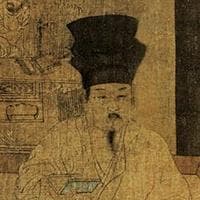
Kişilik
"Li Jing(李璟) hangi kişilik türü? Li Jing(李璟), MBTI, - sx/sp - 'de ISFP kişilik türüdür, , , büyük 5, ' dır."
As a ruler he was even more incapable than Li Yu, but the difference was that unlike Li Yu, he was an ambitious person and had a better sense of political responsibility. He had a future-oriented insight ever since he was a child (consider his poem on the bamboo) and during his reign he launched quite a few projects to expand his empire but gained very little. After defeated by Northern Zhou, this guy fell into an Fi-Ni loop, intuiting pessimistically about the future through a very emotional lens, and thus produced his two most famous poetry. Anyone familiar with his poetry (both shi and ci) will find out that he did not focus on direct sensible expressions but preferred to rearrange them to represent something deeper. This establishes firmly that he was not an Ni inferior. He might also be an incapable INTJ but his Te was too embarrassing. Like most Chinese emperors, he was a tyrant with unreasonable angers but he was also described as a kind person in historical records, which might be typical for ISFPs in power.
Biyografi
Li Jing (Chinese: 李璟, later changed to 李景; 916 – August 12, 961), originally Xu Jingtong (徐景通), briefly Xu Jing (徐璟) in 937–939, courtesy name Boyu (伯玉), also known by his temple name Yuanzong (元宗), was the second ruler (sometimes called Zhongzhu, 中主, lit. 'Middle Ruler') of imperial China's Southern Tang state during the Five Dynasties and Ten Kingdoms period. He reigned his state from 943 until his death. During Li Jing's earlier reign, he expanded Southern Tang's borders by extinguishing smaller neighboring states: Min in 945 and Chu in 951. However, the warfare also exhausted the wealth of the country, leaving it ill-prepared to resist the Later Zhou invasion in 956. Forced to cede all prefectures north of the Yangtze River, he also had to relinquish his title as an emperor and accept Later Zhou's overlordship in 958, and later Song dynasty's overlordship after 960 when Song succeeded Later Zhou.
Kişilik correlate

Olga of Kyiv
Saint Vladimir the Great
Li Yu (Southern Tang)
Otto the Great, Holy Roman Emperor
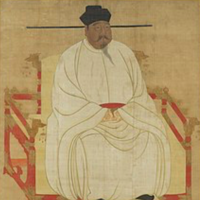
Zhao Kuangyin (Emperor Taizu of Song)

Æthelstan
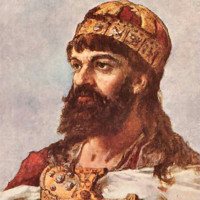
Mieszko I
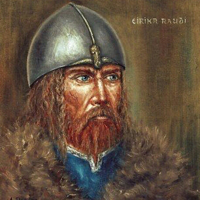
Erik the Red