Jensen Huang MBTI Personality Type
Personality
What personality type is Jensen Huang? Jensen Huang is an INTJ personality type in MBTI, 5w6 - sp/so - 538 in Enneagram, RCOEI in Big 5, LIE in Socionics.
I firmly believe this person is a textbook example of an INTJ with a well-developed tertiary function. 1. The nature of his intuition is distinctly Ni: He hyper-focuses on a single future blueprint dominated by GPUs, converging and integrating everything—such as gaming and AI—into that singular point. He does not view the various paths of gaming, computation, and AI separately; instead, he converges them into the single essence of "parallel computing." Pre-emptively securing that strategic gateway with the GPU is precisely what reveals the concrete blueprint of his intuition. Intuition can only truly be classified as Ni when it manifests this specific trait. (While many attribute Ni to Elon Musk simply because he pursues his various ideas over a long period, the nature of his intuition is fundamentally different. To be Ni, one must converge and integrate everything to the point of distilling it into a single essence. The final conclusion must be that overarching blueprint. Jensen Huang’s intuition serves as the quintessential example of Ni. Ni is only authentic when it converges everything into a single essence to extract one refined, ultimate image. Laying out a diverse array of ideas and pursuing them extensively, as Elon Musk does, is not Ni. Elon Musk is a definitive Ne user—he generates various ideas and connects them through an expansive, outward-facing intuition.) 2. Auxiliary Te (Systematic design for this Ni blueprint): He designs everything to lead to GPUs and aggressively pushes it forward. Some argue he's an ENTJ, but they're wrong. What he ultimately pursues is the specific blueprint provided by Ni, and he merely uses Te as a tool to get there. That's why he once risked bankruptcy by creating a chip that sacrificed practical utility just to serve that GPU-centric future. Even then, he refused to compromise. He built the CUDA ecosystem and seized control of the supply chain for the sake of this fundamental conclusion—the blueprint where all of the world's computation must pass through the GPU to overcome the limits of the CPU. This is the heart of NVIDIA’s Accelerated Computing strategy. Therefore, his auxiliary function is clearly Te. 3. Tertiary Fi: I’ve noticed an interesting pattern—when you watch entrepreneurs present, their tertiary function really shines through. Since the tertiary function is essentially the "play" or "child" function, when they want to make a presentation enjoyable for themselves, they naturally center it around this function. Looking at Jensen Huang, he doesn't deliver the Se-centric presentations (showcasing realistic achievements, metrics, and highly visual data) typical of ENTJs. Instead, he delivers a uniquely INTJ, Fi-centric presentation. It’s an approach that communicates profound authenticity through personal emotions, core values, and personal narratives. Hence, tertiary Fi. 4. Inferior Se: You can see his tendency to minimize external sensory changes and block out sensory overload—like exclusively wearing his signature leather jacket and keeping the exact same hairstyle. This contrasts sharply with ENTJs (who have tertiary Se) and actually enjoy keeping up with trends and playing with sensory variations. 5. An interesting takeaway: My hypothesis about presentations revealing the tertiary function holds up surprisingly well across the board. - Tertiary Se types (ENTJ): They use aesthetically sleek and flashy presentation slides, clearly displaying and flexing tangible results through real-world graphs and metrics. (e.g., Jeff Bezos, Sam Altman, Lisa Su) - Tertiary Fi types (INTJ): They project their genuine authenticity and passion for a project through personal convictions, personal values, internal emotions, and storytelling. (e.g., Jensen Huang, Bernard Arnault) - Tertiary Fe types (ESTP, ENTP): They use Fe to put on highly engaging, show-like performances and demonstrations that spark public inspiration. (ESTP: Larry Ellison, Richard Branson / ENTP: Steve Jobs, Elon Musk). The nuanced difference is that ESTPs channel their Se into Fe, hyping the crowd to revel in overwhelming, tangible realities and sensory thrills. ENTPs, on the other hand, channel their Ne into Fe, hyping the crowd to envision a thrilling, visionary future. But at the end of the day, both are using Fe to put on a spectacular show.
Biography
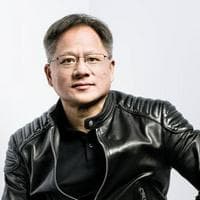
Jen-Hsun "Jensen" Huang is a Taiwanese-American billionaire business magnate, electrical engineer, and co-founder of Nvidia Corporation, where he currently serves as president and CEO.